
Conversions
Roof Pitch in Degrees: 5° to 45° Roofs Converted to X/12
Reviewed by the My Roof Pitch editorial team · Updated
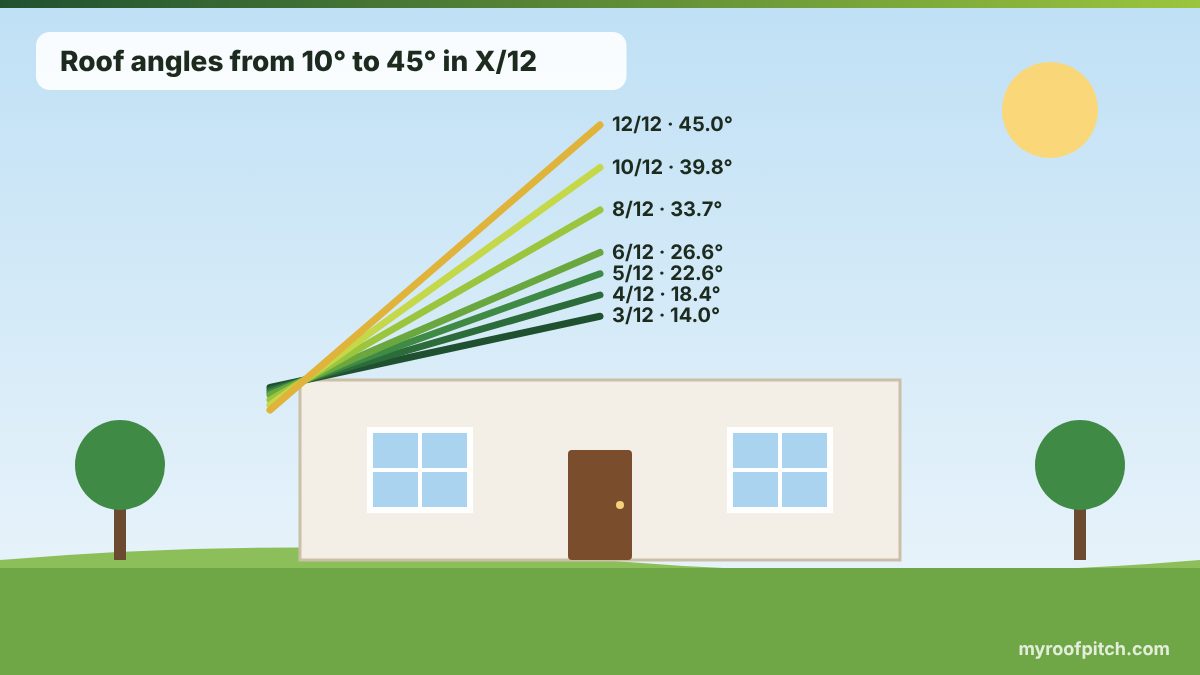
To convert a roof angle to pitch, multiply 12 by the tangent of the angle. A 15 degree roof is 3.22/12, 20 degrees is 4.37/12, 25 degrees is 5.6/12, 30 degrees is 6.93/12 and 45 degrees is exactly 12/12. The area multiplier is 1 ÷ cos(angle), so a 30 degree roof has 15.5 percent more surface than its footprint.
Key takeaways
- Pitch per 12 = 12 × tan(angle). Angle = arctan(pitch ÷ 12).
- Area multiplier from degrees = 1 ÷ cos(angle) — no pitch conversion needed.
- Below about 9.5° (2/12) asphalt shingles are not allowed; below 18.4° (4/12) they need double underlayment.
- Most UK and Australian concrete tiles are rated from about 15° to 22.5° depending on the profile; slate usually needs 20° to 25° or more.
- 30° and 45° are the two angles people ask about most: 6.93/12 and exactly 12/12.
Degree to pitch conversion chart
| Angle | Pitch (X/12) | Slope % | Ratio 1 : X | Area multiplier |
|---|---|---|---|---|
| 5° | 1.05/12 | 8.7% | 1 : 11.43 | 1.0038 |
| 10° | 2.12/12 | 17.6% | 1 : 5.67 | 1.0154 |
| 15° | 3.22/12 | 26.8% | 1 : 3.73 | 1.0353 |
| 20° | 4.37/12 | 36.4% | 1 : 2.75 | 1.0642 |
| 25° | 5.60/12 | 46.6% | 1 : 2.14 | 1.1034 |
| 30° | 6.93/12 | 57.7% | 1 : 1.73 | 1.1547 |
| 35° | 8.40/12 | 70.0% | 1 : 1.43 | 1.2208 |
| 40° | 10.07/12 | 83.9% | 1 : 1.19 | 1.3054 |
| 45° | 12.00/12 | 100% | 1 : 1.00 | 1.4142 |
Every number in the table comes from one right triangle. Rise ÷ run is the tangent of the angle, so pitch per 12 is 12 × tan(angle) and slope percent is 100 × tan(angle). The rafter is the hypotenuse, so its length per unit of run — the area multiplier — is 1 ÷ cos(angle).
10° and 15° roofs
A 10 degree roof is about 2.12/12. That is just above the 2/12 floor for asphalt shingles under the IRC, so shingles are legal only with two layers of underlayment. Standing-seam metal, membranes and many corrugated or trapezoidal sheet profiles are the usual choice. In the UK and Australia, 10° is a common pitch for lean-to extensions, carports and skillion roofs.
A 15 degree roof is 3.22/12. It opens up wood shingles (3/12 minimum) and most exposed-fastener metal panels, and it is the lowest pitch many interlocking concrete tiles are rated for. Check the tile manufacturer's table: low-pitch tiles often need a fully supported underlay and extra headlap at this angle.
20°, 25° and 30° roofs
20 degrees is 4.37/12 — just past the 4/12 line where shingles need only one underlayment layer. It is a very common pitch for Australian hip roofs and project homes. 25 degrees is 5.6/12, close to the 5/12 and 6/12 pitches that dominate US houses, and is a typical minimum for natural slate in the UK.
30 degrees is 6.93/12, which framers almost always round to 7/12. It is a favourite with solar designers because it is near the best fixed tilt for much of the US, southern Europe and Australia's south-east. It is also the angle above which most crews stop walking the roof and set up roof jacks.
35°, 40° and 45° roofs
35 degrees is 8.4/12 and 40 degrees is 10.07/12. Both are steep-slope roofs: expect staging, fall protection and a labour premium. They shed snow quickly and give tall, usable attics. 45 degrees is exactly 12/12 — rise equals run, the rafter is √2 or 1.4142 times the run, and the roof has 41 percent more surface than the footprint.
How to measure a roof angle
- In the attic, hold a digital angle finder or a phone level app against the underside of a rafter and read the angle directly.
- From outside, photograph the gable end square-on and measure the angle in any photo editor or with an on-screen protractor.
- With a level and tape, measure the rise over a 12-inch run and convert with arctan(rise ÷ 12).
- Take readings on at least two rafters — older roofs often sag, and additions are frequently built at a different pitch.
How different countries describe roof pitch
In the US and Canada, pitch is almost always written as rise per 12 inches of run, so plans say 6/12 or 6:12. Roofing material instructions also use this form, and the IRC sets minimums such as 2/12 for asphalt shingles and 4/12 for slate.
In the UK, Ireland, Australia, New Zealand and South Africa, roof pitch is given in degrees on drawings, in building regulations and on tile manufacturers' charts. Builders may also talk about a ratio such as 1 in 4 or a fall in millimetres per metre for low-slope roofs. Converting between these systems is just a matter of the tangent: degrees to X/12 is 12 × tan(angle), and a 1 in X ratio is arctan(1 ÷ X).
Minimum roof angle by material
| Material | Typical minimum | X/12 equivalent |
|---|---|---|
| Membrane (EPDM, TPO, bitumen) | 1° – 2° | 1/4/12 |
| Standing-seam metal | 1.2° – 3° | 1/4/12 – 1/2/12 |
| Corrugated or trapezoidal steel sheet | 3° – 10° | 1/2/12 – 2/12 |
| Asphalt shingles (double underlayment) | 9.5° | 2/12 |
| Asphalt shingles (standard) | 18.4° | 4/12 |
| Interlocking concrete tile | 15° – 22.5° | 3.2/12 – 5/12 |
| Natural slate | 20° – 25° | 4.4/12 – 5.6/12 |
| Plain clay or concrete tile | 35° | 8.4/12 |
These are typical published values. Exposure to wind-driven rain, rafter length and the underlay used can all raise the minimum for a particular roof, so treat the manufacturer's chart for your location as the deciding figure.
Roof angle and solar panels
For fixed solar panels the best year-round tilt is roughly equal to your latitude, reduced by 5 to 15 degrees in many regions because summer production is higher. In practice anything from about 15 to 40 degrees produces within a few percent of the optimum, which is why most pitched roofs suit flush-mounted panels.
Very low roofs (under 10 degrees) lose some output and stay dirtier because rain does not wash the panels as well; installers often add tilt frames. Very steep roofs (over 45 degrees) lose some summer output but shed snow quickly, which can help in northern climates.
Worked conversions
- 15° to X/12: tan(15°) = 0.2679, × 12 = 3.22/12.
- 22.5° to a ratio: tan(22.5°) = 0.4142, so 1 : (1 ÷ 0.4142) = 1 : 2.41.
- 5/12 to degrees: arctan(5 ÷ 12) = arctan(0.4167) = 22.62°.
- A 1 in 6 fall to degrees: arctan(1 ÷ 6) = 9.46°, the same as 2/12.
- Roof area at 30° on a 120 m² footprint: 120 ÷ cos(30°) = 120 × 1.1547 = 138.6 m².
Most phones have a built-in level or measure app that reads angles directly, and the degrees-to-pitch calculator on this site does the tangent step for you, so you can go from a reading on site to an X/12 pitch, a ratio and a material quantity in a few seconds.
Common mistakes when working in degrees
- Treating slope percent as degrees — a 30 percent slope is 16.7°, not 30°.
- Rounding the angle before converting; 30° rounded from 29.6° changes the pitch by 0.1/12 and the area by about half a percent.
- Using a manufacturer's minimum in degrees as if it were X/12, or the other way round.
- Measuring the angle on top of thick tiles or a sagging rafter rather than on a straight section of the structure.
Run the numbers
- Degrees to Pitch CalculatorConvert a roof angle in degrees to an X:12 pitch, percent slope and area multiplier. Shows the nearest standard framing pitch and the tan formula used.
- Roof Pitch to Angle ConverterConvert roof pitch to degrees and back. Enter any X:12 pitch or any angle to get the exact conversion, slope percentage, multiplier and a full reference table.
- Metric Roof Pitch CalculatorMetric roof pitch calculator for the UK, Australia, NZ and South Africa. Enter rise and run in mm or metres for degrees, 1:X ratio and rafter length.
- Roof Pitch CalculatorFree roof pitch calculator. Enter rise and run to get pitch as X:12, the angle in degrees, slope percentage and the pitch multiplier, with a live diagram.
- Sloped Roof Area CalculatorConvert building footprint area to true sloped roof area using the pitch multiplier. Get roofing squares, square metres, and a waste-adjusted order quantity.
Frequently asked questions
What pitch is a 30 degree roof?
6.93/12, usually built as 7/12. The slope is 57.7 percent and the area multiplier is 1.1547.
What pitch is a 45 degree roof?
Exactly 12/12. Rise equals run, the slope is 100 percent and the multiplier is 1.4142.
What pitch is a 15 degree roof?
3.22/12, a 26.8 percent slope. Shingles need double underlayment at this angle; metal and many tiles are fine.
What pitch is a 20 degree roof?
4.37/12, a 36.4 percent slope, with an area multiplier of 1.0642.
What is a 10 degree roof in pitch?
About 2.12/12. It is low slope, best suited to metal sheeting or membranes.
How do I convert degrees to roof pitch?
Multiply the tangent of the angle by 12. For 25°, tan(25°) = 0.4663, × 12 = 5.6, so the pitch is 5.6/12.
What is the minimum roof angle for tiles?
It depends on the tile. Many interlocking concrete tiles are rated from about 15° to 17.5°, plain tiles usually need 35° or more, and the IRC's general minimum for clay and concrete tile is 2.5/12 (about 11.8°) with special underlayment.
What is a 25 degree roof in pitch?
5.6/12, a 46.6 percent slope, with an area multiplier of 1.1034.
What is a 35 degree roof pitch in X/12?
8.4/12, a 70 percent slope. The area multiplier is 1.2208.
Keep reading
- Roof Pitch to Degrees: Full Conversion Chart and FormulaThe complete pitch-to-degree conversion table, the trigonometry behind it, and why 6:12 is 26.57° rather than the 30° people expect.
- Roof Pitch Calculator for the UK and NZ: Degrees, Tiles and FallsWhy UK and NZ tradespeople talk in degrees instead of inches-per-foot, how to convert metric rise and run, and the minimum pitch tables that building control actually checks against.
- 7/12 Roof Pitch: Angle in Degrees, Multiplier and Rafter Lengths7/12 is the step past the 6/12 default — still a normal house roof, but steep enough that staging, labour and the shingle count start to change.
- 12/12 Roof Pitch: Angle, Multiplier and Uses12/12 is the geometric extreme of common residential roofing — a perfect 45-degree triangle that roughly doubles a roof's material, equipment needs and cost compared with a modest 6/12.
Last updated 2026-10-25. Guidance is general information for planning and is not a substitute for a licensed engineer or local code review.